Watching our parents grow older changes the way we think about care.
The question is no longer simply, “Are they healthy?” It becomes:
Are they safe when they are alone?
Are medicines being taken correctly?
Can they visit the doctor without difficulty?
Who will assist them after hospital discharge?
What happens if they fall or suddenly feel unwell?
And most importantly, who can the family trust when they cannot be physically present every day?

These concerns are increasingly common among families in Kolkata, particularly when children live in another city or country.
This is why Trusted Elder Care Services in Kolkata are becoming an important part of modern family support. Good elder care is not merely about arranging an attendant. It is about building a dependable support system around an older person so that they can continue living with dignity, comfort, independence and a greater sense of security.
For families looking for structured senior-support solutions, ELDMaite focuses on making elder care more organised, accessible and family-centred.
Why Elder Care Is Becoming an Important Family Priority in India
India is ageing rapidly.
According to the United Nations Population Fund (UNFPA) India Ageing Report 2023, the country’s elderly population is projected to grow significantly, with people aged 60 and above expected to constitute more than 20% of India’s population by 2050.
This demographic change has major implications for families.
Older adults may live longer, but longevity can also bring changing healthcare, mobility, emotional and day-to-day support requirements.
Some seniors remain completely independent. Others may require occasional assistance. Some need support following surgery or hospitalisation, while individuals living with mobility limitations or multiple chronic conditions may require more coordinated long-term assistance.
The need, therefore, is not simply for “elder care.”
It is for the right level of care for the right person at the right time.
The World Health Organization also advocates person-centred and integrated care for older people, recognising that healthy ageing involves more than treating individual diseases. Mobility, cognitive ability, nutrition, vision, hearing, emotional well-being, social support and the living environment can all affect an older person’s functional independence.
That makes professional elder care particularly relevant for urban families.
What Are Trusted Elder Care Services in Kolkata?
Trusted Elder Care Services in Kolkata are organised support services designed to help senior citizens manage daily living, health-related coordination, mobility, safety and social needs while continuing to live as independently as possible.
Depending on an individual’s requirements, elder-care support may include:
- Daily living assistance
- Senior companionship
- Care coordination
- Doctor-visit assistance
- Hospitalisation and discharge support
- Medicine-related reminders
- Mobility assistance
- Post-hospitalisation support
- Help coordinating diagnostic tests
- Family communication and updates
- Medical equipment on rent
- Emergency coordination
- Longer-term senior-care planning
Not every senior requires all these services.
A reliable elder-care plan begins by understanding what the individual actually needs instead of placing every older adult into the same standard package.
Why Families Search for Elder Care at Home in Kolkata
Kolkata has always had a strong family culture, but the structure of families has changed considerably.
Children may now work in Bengaluru, Mumbai, Delhi, Hyderabad, Europe, the Middle East, the United States or elsewhere. Parents, meanwhile, may prefer to remain in the Kolkata home and neighbourhood where they have spent decades.
This creates a difficult situation:
Parents want independence. Children want reassurance.
Professional elder-care support can help bridge that distance.
Instead of forcing an older parent to leave a familiar environment simply because family members live elsewhere, organised support can help make ageing at home—or ageing in place—safer and more manageable.
The WHO recognises the importance of communities and coordinated services in enabling older adults to age within their familiar environment wherever appropriate.
For many families, therefore, elder care is not about taking independence away from parents.
It is about helping protect that independence for longer.
When Should a Family Consider Professional Elder Care?
There does not need to be a medical emergency before a family starts considering elder-care assistance.
In fact, early planning can often prevent everyday difficulties from becoming crises.
Families should consider professional senior-care support when they begin noticing situations such as:
1. Parents Living Alone
A parent may be physically independent but still need someone dependable for periodic check-ins, appointments, administrative tasks or unexpected situations.
2. Increasing Difficulty with Mobility
Walking, climbing stairs, getting into vehicles or travelling to clinics may gradually become difficult.
A senior may begin avoiding appointments or social activities simply because going outside feels exhausting.
3. Frequent Hospital or Doctor Visits
Managing consultations, prescriptions, reports, tests and follow-up appointments can become complicated, particularly when children live elsewhere.
4. Recovery After Hospitalisation
Hospital discharge does not necessarily mean that a person has fully recovered.
The transition from hospital to home can require temporary assistance with movement, daily activities, follow-up visits and prescribed care instructions.
5. Increasing Forgetfulness
Occasional forgetfulness can occur with age, but noticeable changes should never simply be labelled “normal ageing.”
Families should seek appropriate medical evaluation when required and may also need additional support with everyday routines.
6. Repeated Falls or Fear of Falling
Falls are particularly important in older adults because the consequences can be serious.
Even fear of falling may make an older person reduce normal movement, potentially affecting confidence and independence.
7. Family Caregiver Burnout
Family members frequently become caregivers without any formal preparation.
Balancing work, children, finances and caregiving can eventually become overwhelming.
Seeking professional assistance does not mean the family is abandoning its responsibility.
It means the responsibility is being shared more sustainably.
What Makes Elder Care “Trusted”?
The word trusted matters more than almost any other word in elder care.
A senior may be inviting a caregiver or care coordinator into their home and depending on them during vulnerable moments.
Families should therefore evaluate an elder-care provider carefully.
A Trusted Elder Care Provider Should Focus on These Areas
Individual Assessment
Care requirements should be based on the senior’s health condition, mobility, independence, daily habits, living environment and family circumstances.
Clearly Defined Scope of Support
Families should understand exactly what is and is not included.
Avoid vague arrangements where expectations remain undefined.
Caregiver or Service Verification
Where attendants or personnel are deployed, families should ask about identity verification, training processes and background-verification procedures followed by the provider.
Communication with Family
When children live outside Kolkata, regular communication becomes particularly important.
Families should know whom to contact and how important developments are communicated.
Continuity of Care
Frequent unexplained changes in personnel can be uncomfortable for older adults.
Continuity helps establish familiarity, confidence and routine.
Respect for the Senior
Older people must remain participants in their own care.
Their preferences, routines, privacy and dignity should be respected whenever possible.
Emergency Preparedness
Families should know what happens if the senior becomes unwell, falls or requires urgent hospital assistance.
A documented emergency plan is considerably better than trying to improvise during a crisis.
Elder Care Is More Than Caregiving
One of the most common misunderstandings surrounding senior care is that it simply means hiring someone to stay with an elderly person.
Modern elder care can be much broader.
Think of it as a care ecosystem.
Depending on the person’s needs, that ecosystem could involve:
Daily Support
Help with activities that have become difficult.
Health Coordination
Helping organise appointments, tests, reports or follow-ups according to professional medical advice.
Mobility Support
Helping seniors move safely within or outside their homes.
Hospital Assistance
Supporting families during admission, discharge and follow-up processes.
Social and Emotional Support
Regular human interaction can be particularly valuable for older adults who live alone.
Family Coordination
Keeping authorised family members informed when they live elsewhere.
Equipment Support
Helping arrange required home-care equipment when recommended.
The objective should always remain the same:
Help the older person maintain the highest practical level of safety, dignity and independence.
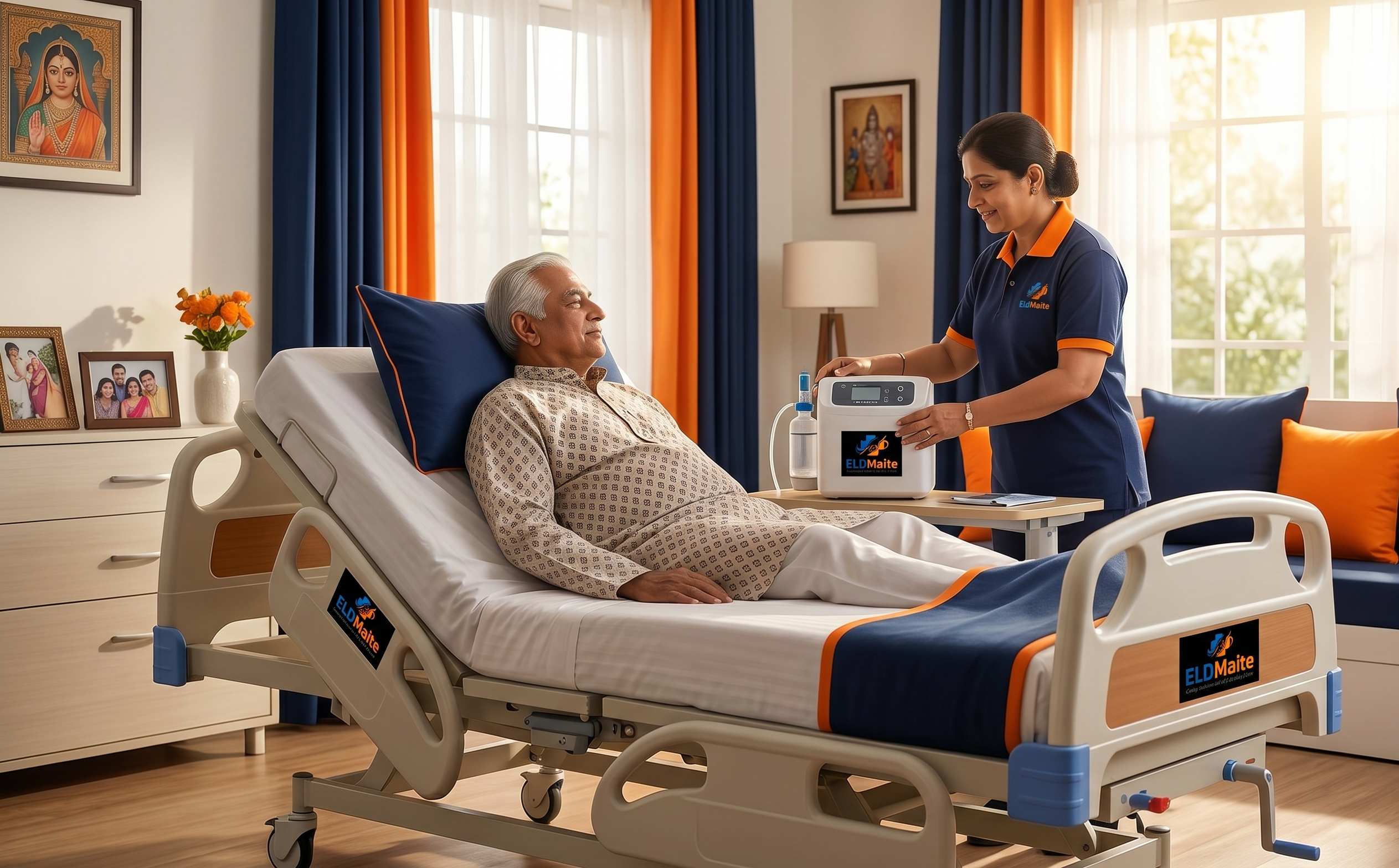
Medical Equipment on Rent in Kolkata: Why It Can Be Useful for Senior Care
Elder care sometimes requires equipment at home, particularly after hospitalisation, surgery, injury or changes in mobility.
Buying every piece of equipment may not always be practical, especially when it is required temporarily.
This is where medical equipment on rent in Kolkata can become useful.
Depending on medical recommendations, individual requirements and availability, commonly required equipment may include:
- Wheelchairs
- Hospital beds
- Walking aids
- Bedside commodes
- Patient-support equipment
- Oxygen-related equipment when prescribed
- Other mobility or recovery-support devices
Rental can be particularly practical when:
- equipment is needed only during recovery;
- doctors are still evaluating long-term requirements;
- a family wants to understand usage before purchasing;
- an elderly parent is temporarily staying in Kolkata;
- the person’s care requirements are changing.
Medical equipment should never be selected simply because another patient used it.
Where the equipment relates to a medical condition, the treating doctor or qualified healthcare professional should determine what is appropriate for the patient.
ELDMaite can help families explore appropriate elder-support arrangements, including coordination around medical equipment rental where available and relevant to the person’s care plan.
Post-Hospital Elder Care: A Frequently Overlooked Stage
Families understandably feel relieved when an elderly parent is discharged from hospital.
But discharge is often only the beginning of recovery.
At home, families may suddenly need to coordinate:
- medicines,
- follow-up consultations,
- investigations,
- mobility,
- diet instructions,
- physiotherapy where prescribed,
- home equipment,
- wound-care appointments where professionally advised,
- transportation,
- and assistance with daily activities.
This transition can become difficult when the primary family caregiver works full-time or lives outside Kolkata.
A properly planned post-hospital elder care service in Kolkata can help families organise this transition and ensure that non-clinical support requirements do not get overlooked.
Clinical decisions, however, should always remain under the direction of the treating doctor or appropriately qualified healthcare professional.
Elder Care for Parents When Children Live Outside Kolkata
One of the strongest use cases for organised elder care is the long-distance family.
Imagine an elderly couple living in Kolkata while their children live in Mumbai, Bengaluru, London or Dubai.
A small health issue arises.
The child receives a phone call but cannot immediately determine:
- how serious the situation is,
- whether someone should accompany the parent,
- which medical reports are required,
- how transportation will be arranged,
- or who can remain available locally.
This is where having a trusted local elder-support system becomes valuable.
Instead of searching for help only after every emergency occurs, the family already has a point of coordination.
For NRIs and children living outside Kolkata, professional elder support can therefore provide something extremely important:
visibility and reassurance from a distance.
Technology can connect families through a phone screen.
Reliable local support connects them when physical presence is required.
Companion Care Matters Too
Not every elder-care requirement is medical.
Loneliness and social isolation can also affect the quality of later life.
A senior may have stable health yet spend large amounts of time alone because children live elsewhere, friends have moved away or reduced mobility makes social interaction difficult.
Companionship can include simple but meaningful activities such as:
- conversation,
- reading,
- accompanying a senior on a walk,
- helping them participate in hobbies,
- accompanying them to social engagements,
- facilitating communication with family,
- or simply being present.
Good elder care should therefore see the person before the patient.
Ageing should not reduce someone to a collection of prescriptions and medical reports.
How to Choose Trusted Elder Care Services in Kolkata
If you are comparing providers, use this practical checklist.
1. Ask for a Proper Needs Assessment
Do not begin with:
“What package should I purchase?”
Begin with:
“What does my parent actually need?”
A 68-year-old independent senior living alone requires a completely different care plan from an 84-year-old recovering from a hip surgery.
2. Understand Who Will Enter the Home
Ask about the provider’s process for selecting and verifying personnel.
Clarify:
- identity-verification processes,
- experience,
- relevant training,
- responsibilities,
- supervision,
- replacement procedures,
- and escalation mechanisms.
3. Ask About Family Updates
If you live away from Kolkata, determine how updates will be shared.
A care arrangement should reduce uncertainty rather than create more of it.
4. Ask About Emergencies Before an Emergency Happens
Who is contacted first?
Which hospital is preferred?
Where are medical documents kept?
Who has authority to make specific decisions?
Which relatives or neighbours should be contacted?
These discussions are much easier to have before an emergency occurs.
5. Look for Flexibility
Senior-care needs often change.
Someone may initially need only periodic assistance but later require greater support following an illness or surgery.
Choose a system capable of adapting rather than forcing the family into a rigid arrangement.
6. Never Choose Elder Care on Price Alone
Cost matters, but elder care is a high-trust service.
The lowest quotation is not necessarily the most appropriate option.
Compare:
- service scope,
- reliability,
- verification procedures,
- communication,
- responsiveness,
- continuity,
- and transparency.
The real question should be:
“Who would I trust to support my parent when I cannot be there?”
A Simple Elder-Care Planning Framework for Families
Families can use the following five-part framework before choosing an elder-care plan.
AreaQuestions to AskHealthAre there chronic conditions, recent surgeries or frequent appointments?MobilityCan the senior walk, use stairs and travel independently?Daily LivingWhich everyday activities have become difficult?Social Well-beingDoes the senior regularly interact with other people?Emergency ReadinessIs there a clear plan for sudden illness, falls or hospitalisation?
AreaQuestions to AskHealthAre there chronic conditions, recent surgeries or frequent appointments?MobilityCan the senior walk, use stairs and travel independently?Daily LivingWhich everyday activities have become difficult?Social Well-beingDoes the senior regularly interact with other people?Emergency ReadinessIs there a clear plan for sudden illness, falls or hospitalisation?
Revisit this assessment periodically.
Elder-care planning should evolve because ageing itself is dynamic.
Why Ageing at Home Matters to Many Kolkata Families
A home is more than a physical space.
For an older adult, it may hold decades of memories.
The neighbourhood pharmacy knows them.
The local doctor knows their history.
The shopkeeper recognises them.
Friends and relatives may live nearby.
Their daily routine feels familiar.
Moving away can therefore be emotionally difficult even when children have good intentions.
Where health and safety conditions allow it, structured support can help seniors remain in their familiar environment longer.
This concept is commonly described as ageing in place.
It does not mean leaving an older adult alone.
It means building sufficient support around them so that remaining at home continues to be practical and safe.
ELDMaite: Building a More Organised Approach to Elder Care
Families do not merely need another contact number.
They need dependable coordination.
ELDMaite is focused on supporting families looking for trustworthy and organised elder-care solutions, particularly when ageing parents require assistance but wish to maintain their independence and familiar lifestyle.
The approach to elder support should begin with understanding the individual rather than treating every senior the same.
Depending on requirements and service availability, elder-care planning can involve everyday support, coordination around healthcare requirements, post-hospital needs, mobility assistance, family communication and access to supporting resources such as medical equipment on rent.
The objective is simple:
Make caring for ageing parents easier to organise without taking dignity away from the person receiving care.
Beyond Kolkata: ELDMaite’s Growing Elder-Care Network
The challenge of caring for ageing parents is not unique to Kolkata.
Families across India’s major cities face similar situations as children move for careers while parents prefer to remain in their established homes.
ELDMaite’s model therefore extends beyond Kolkata, with its franchise model also present in Delhi and Mumbai.
This growing network reflects a larger shift in India:
Elder care is gradually moving from informal, emergency-based arrangements toward more organised and professional support systems.
Whether a family is looking for elder care in Kolkata today or exploring senior-support solutions for parents in Delhi or Mumbai, the fundamental requirement remains unchanged:
care must be reliable, respectful, responsive and centred around the older person.
Trusted Elder Care Services in Kolkata for NRI Families
For NRI families, geographical distance can amplify every concern.
A missed phone call can create anxiety.
A doctor’s appointment may require complicated coordination.
A minor fall can suddenly require someone trustworthy on the ground.
Professional elder-care support can function as a local extension of the family.
It cannot replace a son, daughter or loved one—and it should never pretend to.
What it can do is provide practical assistance when the family cannot physically reach Kolkata immediately.
That distinction is important.
The best elder-care services do not attempt to replace families.
They strengthen the family’s ability to care.
Frequently Asked Questions About Elder Care in Kolkata
What are the best elder care services in Kolkata?
The best elder-care service depends on the individual’s needs. Families should prioritise providers offering transparent services, proper assessment, personnel-verification processes, dependable communication, emergency planning and flexible care arrangements rather than choosing solely on price.
How can I find trusted elder care services in Kolkata for my parents?
Start with a needs assessment covering health, mobility, daily activities, social support and emergency readiness. Then compare providers based on verification procedures, experience, service scope, responsiveness, family communication and continuity of care.
Can elderly parents receive care while continuing to live at home?
Yes. Many seniors can continue living at home when their health condition and living environment allow it and appropriate support is available. The required level of assistance varies from occasional coordination to more regular support.
Is elder care useful if my parents are currently independent?
Yes. Elder care does not have to begin only after someone becomes dependent. Independent seniors living alone may benefit from check-ins, appointment assistance, emergency planning, companionship or occasional coordination.
What is post-hospital elder care?
Post-hospital elder care supports an older person during the transition from hospital to home. Depending on medical instructions and personal requirements, this may involve help coordinating follow-ups, mobility, daily activities, prescribed therapy, equipment and other recovery-related needs.
Can medical equipment be rented for elderly patients in Kolkata?
Yes, various types of home-care and mobility equipment can be available on rent in Kolkata. The appropriate equipment should be selected according to the person’s condition and professional medical recommendations where applicable.
What medical equipment may be useful for senior citizens at home?
Depending on an individual’s condition, doctors or healthcare professionals may recommend equipment such as a wheelchair, walking aid, hospital bed, bedside commode or other recovery-support equipment. Requirements vary substantially between individuals.
How can NRIs arrange elder care for parents in Kolkata?
NRI families can work with a local elder-care provider that offers clear communication, documented contact information, defined responsibilities, family updates and emergency coordination. The family’s preferred doctors, hospitals and emergency contacts should ideally be documented in advance.
Is elder care only for sick senior citizens?
No. Elder care can also support healthy or largely independent seniors who need companionship, appointment assistance, mobility help, occasional coordination or additional security while living alone.
Does ELDMaite provide services outside Kolkata?
ELDMaite’s elder-care network includes a franchise model in Delhi and Mumbai in addition to its presence associated with Kolkata, helping extend organised elder-support solutions to families across multiple metropolitan cities.
Questions to Ask Before Hiring an Elder-Care Provider
Before finalising any service, ask:
- How do you assess my parent’s actual requirements?
- What exactly is included in the proposed care arrangement?
- How are personnel selected and verified?
- Who supervises the service?
- What happens if the assigned person is unavailable?
- How are family members updated?
- What is the emergency escalation process?
- Can services change if my parent’s requirements change?
- How are payments and charges documented?
- Who should we contact if we have a concern?
A professional provider should be comfortable answering reasonable questions.
Trust should never depend on assumptions.
Preparing Your Parents’ Home for Safer Ageing
Professional support is only one component of elder care.
Families should also regularly review the home environment.
Consider checking:
- bathroom flooring and grab-support requirements,
- adequate lighting,
- loose rugs or wires,
- stair safety,
- frequently used items placed within easy reach,
- emergency numbers displayed visibly,
- medication organisation,
- safe footwear,
- and ease of movement through the home.
Simple environmental changes can make everyday living easier.
Where mobility or medical concerns exist, seek recommendations from appropriate healthcare professionals rather than making major changes based solely on general online advice.
Elder Care Should Protect Independence, Not Remove It
One of the biggest mistakes families can make is assuming that ageing automatically means losing the ability to make decisions.
It does not.
Whenever possible, seniors should participate in discussions concerning their:
- daily routines,
- caregiver preferences,
- medical appointments,
- living arrangements,
- social activities,
- and overall care plan.
Good elder care is not about controlling an older person’s life.
It is about providing enough support for them to continue living it.
The Future of Elder Care Is Personal, Local and Connected
India’s demographic transition means elder care will become an increasingly important part of family planning in the coming decades.
But good elder care cannot be built around fear.
It should be built around preparedness.
Families need systems that combine:
human connection + practical assistance + healthcare coordination + family communication + dignity.
For Kolkata families, particularly those with children living elsewhere, having dependable local support can transform elder care from a series of emergencies into a structured plan.
And that is ultimately what families searching for Trusted Elder Care Services in Kolkata are looking for:
Not simply someone who is available.
Someone they can depend on.
Looking for Trusted Elder Care Services in Kolkata?
If your parents are ageing independently, recovering after hospitalisation, experiencing mobility challenges or simply need reliable support while you live away from Kolkata, planning early can make a significant difference.
Connect with ELDMaite to explore an elder-care plan based on your family’s actual requirements.
Support may also include coordination around medical equipment on rent, where applicable and subject to individual requirements and availability.
Because elder care should never begin with a package.
It should begin with understanding the person.
References & Further Reading
For readers who want to explore evidence-based information on healthy ageing and senior care, useful authoritative resources include:
- World Health Organization — Ageing and Health
- World Health Organization — Integrated Care for Older People (ICOPE)
- UNFPA India & International Institute for Population Sciences — India Ageing Report 2023
- Directorate General of Health Services, Government of India — National Programme for Health Care of the Elderly (NPHCE)
This article provides general information about elder care and is not a substitute for medical diagnosis, treatment or advice from a qualified healthcare professional.